The Strait of Hormuz, the world’s most critical oil chokepoint carrying roughly 20% of global oil trade (around 20–21 million barrels per day pre-disruptions), is rapidly losing its stranglehold. According to Goldman Sachs analyst Alexandra Paulus, pipeline projects across the Gulf are on track to divert up to 45% of pre-war Persian Gulf oil exports by the end of 2027, with bypass capacity reaching 7.3 million barrels per day (bpd) — or 60% of the Gulf’s oil — by the end of 2028.
This infrastructure boom, accelerated by regional tensions and Iran’s threats to close or weaponize the strait, is systematically engineering the chokepoint out of existence. Gulf producers are building “strait-proof” export routes, and with additional global supply coming online elsewhere, Iran’s role in world oil markets is set to shrink dramatically.
UAE Leads with Massive West-East Pipeline Expansion
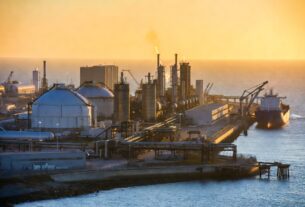
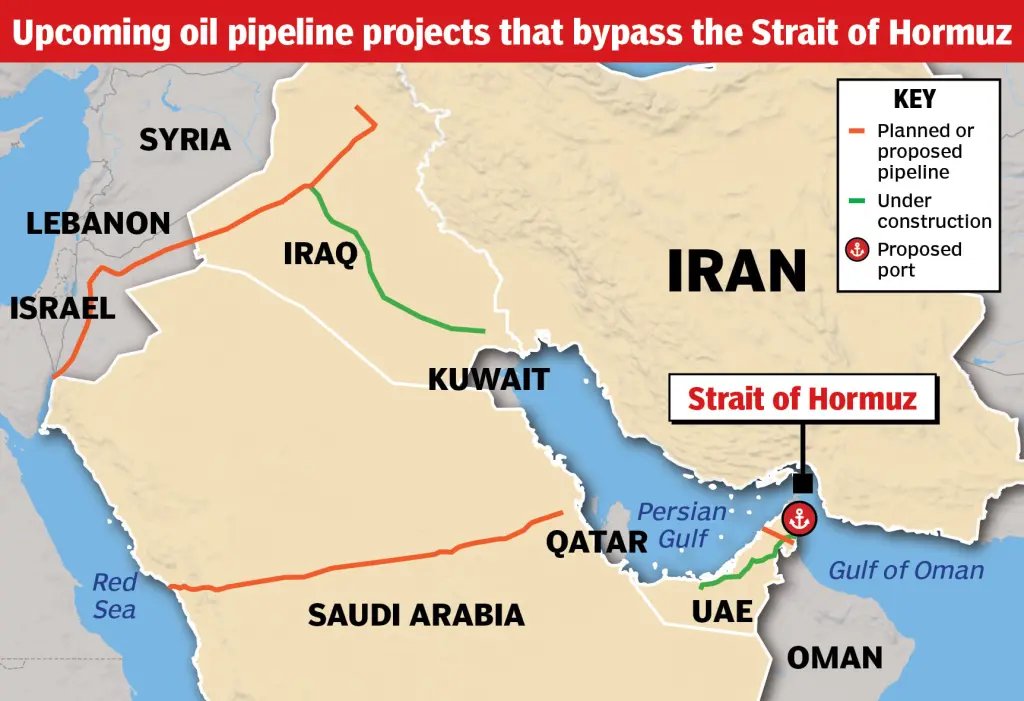
The UAE is the furthest along. Its new West-East Pipeline (parallel to the existing Habshan-Fujairah line) is already 50% complete. Crown Prince Sheik Khaled bin Mohamed bin Zayed has ordered full completion by 2027, doubling overland bypass capacity to 3.6 million bpd through the Fujairah terminal on the Gulf of Oman — safely outside the Strait of Hormuz.
ADNOC Chairman Sultan Al Jaber has emphasized the strategic logic: “Right now, too much of the world’s energy still moves through too few choke points.”The UAE is also advancing plans for a new deep-water port and container terminal on the Arabian Sea side to further reduce reliance on Hormuz.
Iraq Accelerates Multiple Bypass Routes — Backed by Trump Meeting
Iraq is moving aggressively on two major fronts:
The Basra-Haditha pipeline ($1.5 billion project, 435 miles long) aims to carry 2.5 million bpd from southern fields toward Jordan, Syria, and Turkey. Construction began in May 2026.
Revival of the long-dormant Kirkuk-Baniyas pipeline (approximately 500 miles through Syria to the Mediterranean). Original capacity was around 300,000 bpd. Feasibility studies involving Chevron and partners are advancing rapidly following high-level U.S. engagement.
In a notable July 14, 2026, White House meeting, President Trump hosted Iraq’s new Prime Minister Ali al-Zaidi. Discussions centered on deepening U.S.-Iraq energy ties, oil field deals (including Chevron’s expanded role at West Qurna-2 and other fields), and advancing pipeline infrastructure to bypass the Strait of Hormuz. The Kirkuk-Baniyas revival was highlighted as a key diversification play. Trump also signaled a reduced long-term U.S. military footprint in Iraq as Iranian influence wanes.
Saudi Arabia Eyes Major Red Sea Expansion
Saudi Arabia is in preliminary talks to expand its existing East-West Crude Oil Pipeline (currently up to ~7 million bpd to Yanbu on the Red Sea) by up to 2 million bpd more — potentially reaching 9 million bpd total bypass capacity. Discussions include neighboring countries and could involve refined products as well.
This would give the Kingdom enormous flexibility to route oil westward, away from Iranian threats.
Kuwait Eyes Tapping into UAE and Saudi Systems
Kuwait, which remains almost entirely dependent on the Strait, is actively exploring tie-ups. Kuwait Petroleum Corporation (KPC) CEO Sheik Nawaf al-Sabah has confirmed discussions with Saudi Arabia and the UAE to expand existing pipeline systems to accommodate Kuwaiti barrels.
If capacity is added (especially via the UAE’s expanding Fujairah route or Saudi expansions), Kuwait could divert a meaningful portion of its ~2.5–3 million bpd exports overland.
Adding It Up: A Combined Bypass Surge Toward Goldman’s 7.3 Million bpd Target
Here’s a realistic tally of the major projects in motion:
- UAE West-East expansion: +~1.8 million bpd (total bypass 3.6 million bpd by 2027)
- Iraq Basra-Haditha: 2.5 million bpd
- Iraq Kirkuk-Baniyas revival: ~0.3 million bpd
- Saudi East-West expansion: +1–2 million bpd
- Kuwait potential tie-in: 0.5–1+ million bpd (depending on added capacity)
Combined potential: Easily 7+ million bpd of new or expanded bypass capacity by 2028 — aligning closely with Goldman Sachs’ 7.3 million bpd / 60% projection.
Even if only 60–70% of these ambitious projects come online on schedule, the diversion will be transformative.
Broader Global Supply Growth Further Marginalizes Iran
While Gulf bypass infrastructure expands, non-Gulf supply continues ramping up:
- U.S. shale production remains robust.
- Guyana’s offshore boom (led by ExxonMobil) is on track for major increases.
- Brazil, Canada, and other producers are adding hundreds of thousands of barrels daily.
These sources operate far from Iranian influence or Hormuz risks. As bypass routes multiply and alternative supply grows, Iran’s ability to influence global prices through strait threats diminishes sharply. Iran’s own exports remain heavily constrained by sanctions and regional instability, making it increasingly marginal in the global energy equation.
The Bottom Line: Iran Becomes Insignificant
The infrastructure now under construction represents the most permanent strategic shift in decades. Every new mile of pipeline laid erodes Iran’s decades-long leverage over the world’s oil lifeline.
By 2028, the Strait of Hormuz will still matter — but it will no longer function as an effective “gun to the world’s head.” Gulf producers (and their customers) have chosen engineering solutions over perpetual vulnerability.
Iran played its chokepoint card aggressively. The region’s response is to build it out of relevance.
Iran will be left behind.
Appendix: Sources & Links
- New York Post (July 14, 2026): “Middle East allies rushing new pipelines, port to bypass Iran’s grip on Strait of Hormuz” – Primary source for Goldman Sachs estimates and project overviews.
https://nypost.com/2026/07/14/world-news/middle-east-allies-rushing-new-pipelines-port-to-bypass-irans-grip-on-strait-of-hormuz/ - The National / ADNOC announcements (May 2026): UAE West-East Pipeline expansion details and 2027 timeline.
https://www.thenationalnews.com/business/energy/2026/05/15/uaes-west-east-pipeline-expansion-to-become-operational-in-2027-doubling-oil-export-capacity/ - Reuters (July 7, 2026): Saudi Arabia considers expansion of oil pipeline to Red Sea.
https://www.reuters.com/business/energy/saudi-arabia-considers-expansion-oil-pipeline-red-sea-sources-say-2026-07-07/ - Argus Media (June 10, 2026): Kuwait eyes regional pipeline tie-ups to bypass Hormuz.
https://www.argusmedia.com/en/news-and-insights/latest-market-news/2837499-kuwait-eyes-regional-pipeline-tie-ups-to-bypass-hormuz - Energy News Beat (July 2026): Coverage of Trump–Iraqi PM al-Zaidi meeting and pipeline developments.
https://energynewsbeat.co/crude-oil/president-trump-meets-with-iraqi-prime-minister-over-oil-deals-new-pipeline-and-reduced-u-s-military-footprint/ - Mario Nawfal / X Post (July 15, 2026): Summary thread drawing on the above reporting.
https://x.com/MarioNawfal/status/2077237972118671672
Additional context drawn from ADNOC, Iraqi government statements, and industry reporting on the Kirkuk-Baniyas revival and Chevron involvement.